
Performance/installation, Safehouse 1 & 2, Peckham, London, May 2016
Birdcage, wooden bench, sound (18'51", looped)
Seasons
The Location
Seasons was made for the same Graduate Diploma Fine Art Offsite exhibition as Rituals — the same abandoned Victorian house in Peckham, the same invitation to respond to its worn floors, its former domestic life, the quality of light and absence that gathers in a space once lived in and left. Where Rituals answered the site's pull toward fire and release, Seasons answered something quieter: the architecture itself. An empty room. A window. The silence of objects arranged in a space no longer inhabited.
The Room
The room was cold, and dim except for the one window, which let in the low, grey light of a London May during the day. Modest in scale, neither large nor cramped, with worn wooden floorboards underfoot and exposed beams overhead. The installation itself was sparse by design: a birdcage hanging from the ceiling, a narrow wooden bench in the corner, sitting beneath the room's only window. Nothing explained itself. Visitors walked into a room that felt paused mid-thought and furnished just enough to suggest a life that had recently left it.
The bench was already there when the room was found — it was recognised immediately as the right place for someone to sit and think. Nothing about Seasons was planned in advance as a whole. The window suggested the bench. The bench suggested the birdcage. The birdcage suggested the music. Each element answered the one before it, rather than following a predetermined design — the room assembled itself through a chain of responses.
The Cage
The birdcage wasn't found as it appears in the room — it was sought out, bought painted white, and then deliberately stripped back. I scraped the white paint off by hand until the bare metal underneath was exposed. Removing the floor undid the cage's one function; scraping off the paint undid its presentable surface. Both gestures point the same way: toward revealing something that had been covered over. A cage is often dressed up to look decorative — a pretty object before it is recognised as a container for something trapped. Stripping that away refused the disguise: underneath was only bare, tarnished metal, honest about what it actually was. And a cage with no floor can no longer hold anything - it becomes, instead, the shape of an opening. Both gestures ask the same question: what is left once the pretense is gone, and what is set free once it is.
The theme predates this piece. Long before Chelsea, the artist often drew birds — always mid-flight, never caged. Whatever was understood then about wanting release is still what this piece is asking about now.
The Music
Music played on loop throughout the exhibition, its source deliberately hidden — not just concealed, but physically tucked into the architecture: a small speaker wedged into the ceiling beams, so the sound came from inside the building itself rather than being played into the room from outside it. Walking in, you couldn't tell where the music was coming from, only that it was there, giving the space a dreamlike, unplaceable quality, as if the room itself were remembering something.
Four pieces, looped throughout:
阿嬤彈鋼琴 (a recording of the artist’s grandmother playing piano), Pina Bausch performance, "Seasons march", Dead Can Dance, "Song of the Stars", Jun Miyake, "Lilies of the Valley".
The Invitation
Unlike Rituals, Seasons offered no instructions. Nothing was asked of visitors. Whoever entered the room was left to make of it what they could: to sit on the bench or not, to notice the birdcage's missing floor or not, to hear the hidden music as ambient or as meaningful. The room made no claims about what it meant. It offered only the conditions — the window, the cage, the bench, the sound — and let each visitor decide what, if anything, they were feeling
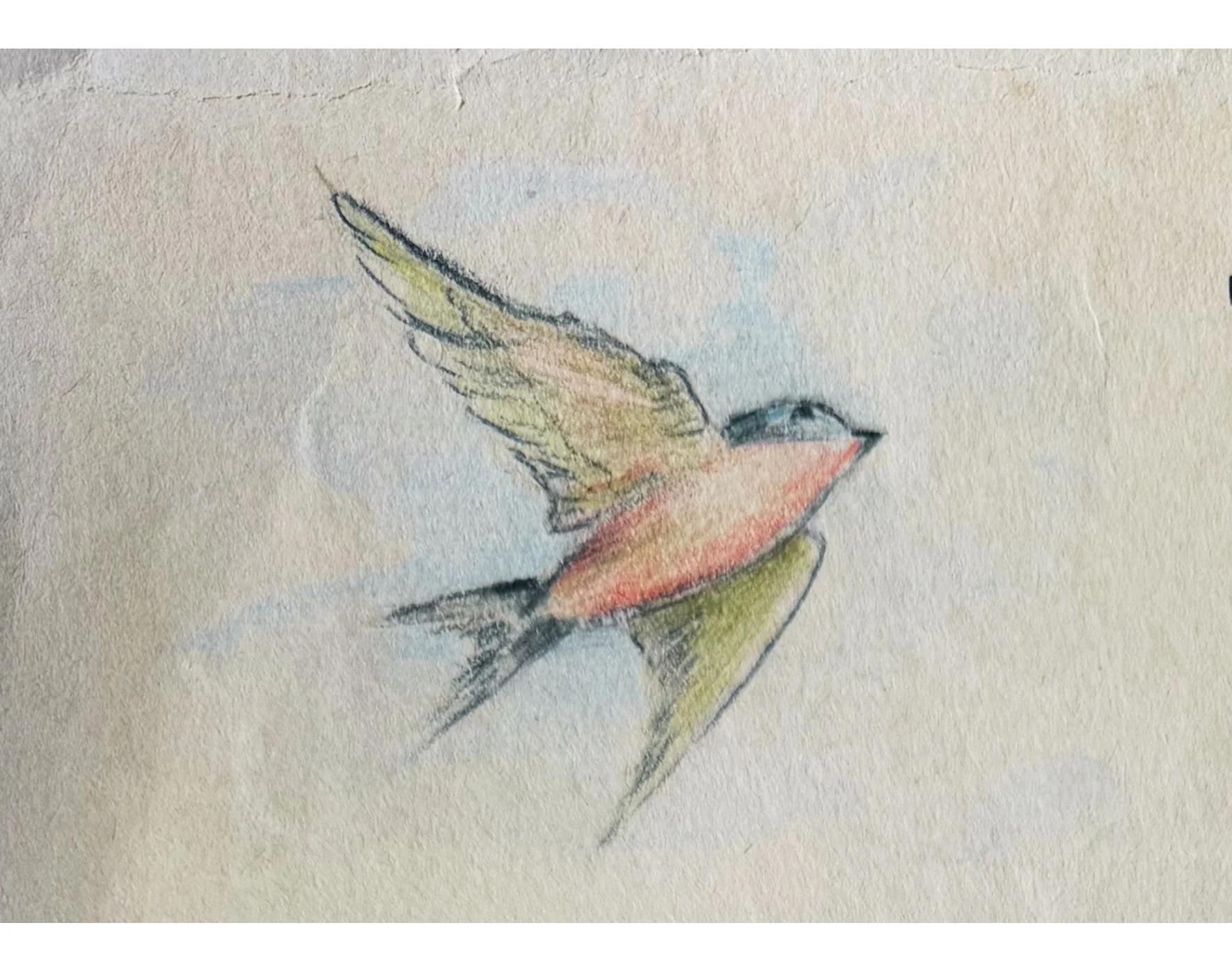
Sketchbook drawing, predating the piece
阿嬤彈鋼琴 (a recording of the artist’s grandmother playing piano)